

%20(77)%20(1).png)
After one of AIRINC and GTN’s Summer Mobility Tax School webinars wrapped up, an attendee sent in a photo that quickly became a favorite among the team: a cat sitting in front of the screen, apparently having followed along with the session on global mobility taxation!
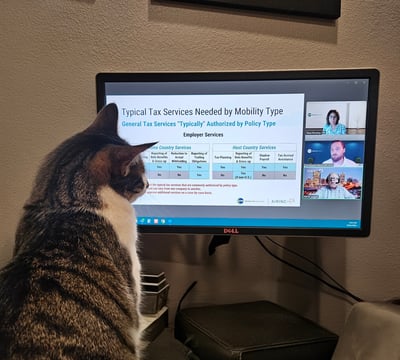
Mobility tax may not be the most obvious candidate for casual viewing, yet in today’s global workforce environment, it commands attention. As organizations manage long-term assignments, frequent business travel, and cross-border remote work, tax considerations increasingly sit at the center of cost control, compliance, and the employee experience.
Below are the key themes mobility leaders should focus on as they plan for 2026 and beyond.
The Building Blocks of Mobility Tax Still Matter
Despite evolving work models, the fundamentals of mobility tax remain the foundation of every global mobility program.
At the core are residency and sourcing rules, which determine where income is taxed. Even short-term travel or hybrid work can create obligations when work is performed outside the home country.
Tax treaties play an important role in relieving double taxation, but they are frequently misunderstood. Treaty protection depends on thresholds, duration, and who bears the cost of employment. They do not automatically eliminate host-country tax exposure.
Social security is another critical, and often underestimated, component. Totalization agreements can allow employees to remain in their home-country system, but only when certificates of coverage are properly obtained and maintained.
Finally, benefit taxability and gross-up methodology materially affect assignment cost. Housing, relocation, home leave, and per diems may be taxable depending on jurisdiction, and gross-up strategy can significantly influence total program spend.
Strong mobility programs continue to invest in getting these fundamentals right before layering on complexity.
Mobility Tax Risk Is Expanding Beyond Traditional Assignments
Tax risk is no longer confined to long-term expatriate assignments.
Remote work across borders, frequent business travel, and informal short-term assignments are now among the most common sources of exposure. In many organisations, policies and tracking systems have not fully caught up with how work is actually performed.
Business travelers and so-called “stealth assignees” remain particularly challenging. Responsibility for monitoring travel often sits across HR, payroll, tax, and travel teams, leading to fragmented ownership and inconsistent oversight.
A persistent risk is the over-reliance on tax treaties to manage short-term travel exposure. Treaty thresholds are nuanced, and host-country obligations may still arise depending on income level, recharge arrangements, and employment structure.
The takeaway for mobility leaders is clear: effective risk management requires governance, not just technical tax expertise. Clear ownership, accurate tracking, and cross-functional coordination are essential.
Compensation, Equity, and Benefits Are Driving New Complexity
As mobility patterns diversify, compensation structures are becoming harder to manage from a tax perspective.
Deferred compensation, such as bonuses and long-term incentives, often spans multiple jurisdictions. If income is not properly allocated to where work was performed, organisations risk incorrect withholding and reporting.
Equity compensation presents even greater challenges. Grant, vesting, exercise, and sale events may each be taxed differently across countries, requiring careful coordination between mobility, payroll, and equity administrators.
Pensions and retirement plans add another layer of complexity. Contributions and distributions are treated differently around the world, and not all plans qualify for treaty relief.
Social security remains tightly linked to compensation planning. Without proactive management, employers may face double contributions or unexpected costs, particularly for employees with hybrid or multi-country work patterns.
These issues underscore the importance of aligning tax, reward, and mobility strategy rather than treating them as separate disciplines.
Global Mobility Tax in Context: Key Developments from 2025
Regulatory and border-control changes in 2025 added further complexity to mobility tax planning. Several developments deserve special attention.
New mandatory pension contributions for foreign employees in Malaysia
Beginning with wages for October 2025 (contributions payable in November 2025), foreign nationals working in Malaysia are now required to participate in the Employees Provident Fund (EPF), contributing 2 percent employee and 2 percent employer.
This increases the baseline cost of inbound assignments and may require adjustments to compensation packages.
New border-entry tracking in the European Union: EU Entry/Exit System
The Entry/Exit System (EES), which began rolling out in October 2025, replaces passport stamping with biometric and electronic tracking for non-EU travelers entering and exiting the Schengen Area.
Accurate digital tracking means that residency, tax residency, and social security exposure are more easily scrutinized. Frequent travelers and remote workers may be more likely to trigger thresholds that require employer action.
These developments reinforce the importance of integrated tax, immigration, and compliance planning.
What This Means for Mobility Programs
Across these themes, several priorities emerge:
- Invest in strong tax fundamentals
- Clarify governance and ownership across teams
- Integrate tax considerations into compensation and benefit design
- Monitor global regulatory developments continuously (watch Global Tax Chat!)
- Use data and modelling tools to support proactive decision-making
Mobility tax success increasingly depends on anticipation rather than reaction.
Continuing the Conversation: Join us for Global Tax Chat
January 15, 2026
9:30 AM Boston / 2:30 PM London
If you rely on mobility tax insights to guide cross-border assignments or global workforce strategy, you need to join us on the next Global Tax Chat Show!
On January 15, 2026, we plan to cover:
- India court ruling on Provident Fund contributions by International Workers
- Changes to Belgium expat regime
- OECD model convention updated for remote workers
- OB3 2026 tax changes.
Along with a deep dive into what is hypo tax.
Bring your coffee and your questions for me and Jeremy Piccoli, as we discuss the key tax developments that all Global Mobility professionals should be aware of in the coming months. Grace Pursley will be at the helm, making sure we stay sharp, sip our coffee, and maybe even laugh while we tackle the serious stuff!
Are you looking for information on global tax rates around the world?AIRINC’s International Tax Guide contains all of the information you need to support your assignment tax planning — including global tax rates, deductions, and employee/employer social security contributions. |
Want to watch again?Rewatch the AIRINC and GTN Summer Mobility Tax School sessions here: Mobility Tax 101 - Foundations of Global Mobility Taxation |
What’s Driving the Cost of Mobility?Global mobility isn’t just about moving people—it’s about making smart talent investments. Every assignment or transfer carries a price tag, and those costs can look very different depending on the route, policy, and structure. Leveraging AIRINC data and our tax engine, we used the Assignment Cost Estimator (ACE) to create a new infographic to encourage you to advise and influence with data. |
%20-%202026-02-04T222549.716%20(1).png)
%20(1).png)
%20(18).jpg)