

.png)
Excitement around the World Cup is already building, especially for those of us based in the U.S. Mexico and Canada, where the tournament will bring even more attention, energy, and anticipation to the game.
Tom: Similar to the World Cup bringing the world together, we are running a FIFA World Cup office pool to bring the company together. It’s been a fun way to get into the World Cup spirit, root for countries we may have never rooted for before, and provides friendly competition amongst colleagues.
Yaira: I had the chance to attend two World Cup matches in Dallas and Houston, and for my first-ever World Cup experience, it absolutely lived up to the excitement. The atmosphere was electric - fans from every corner of the world proudly representing their countries, teaching me chants, songs, and even pulling me into spontaneous dance parties outside the stadium in the Texas heat. No matter what kit you were wearing, everyone was celebrating the match together.
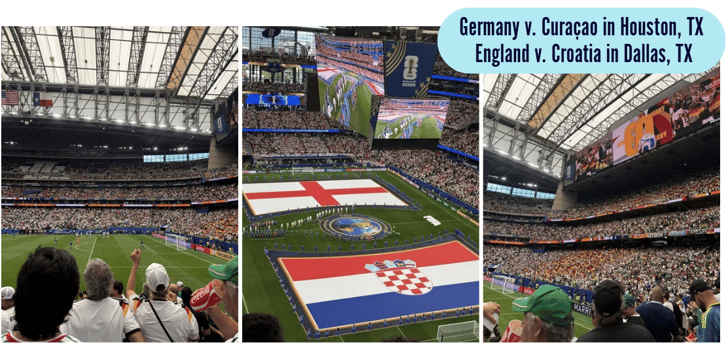 Due to all of these experiences, watch parties have become a popular event in our households and communities.
The tournament has also been part of recent AIRINC conversations. In our latest Global Tax Chat, we looked at how a global sporting event can raise very real mobility questions. From where players compete to how tax rules apply across borders. The broader takeaway was familiar to mobility professionals: location matters, and even short periods in a place can create different costs, obligations, and experiences. Watch again here.
That got us thinking about the World Cup from another angle. After reading that major tournaments can sometimes give TV sales a boost, we started wondering: what would it actually cost to host a World Cup watch party in different places around the world?
With help from AIRINC’s data department, we pulled together a light-hearted comparison of watch party costs across 10 global expat hubs. From snacks and drinks to the cost of buying a new TV, the results offer a fun way to look at something mobility professionals know well: the price of everyday experiences can vary significantly depending on where you are.
Why compare World Cup watch party costs?
Rather than attempt a global sweep, we focused on 10 major expat hubs, places where internationally mobile employees might be living, working, and watching. These are destinations where a major global event like the World Cup is just as likely to be watched from a sofa in Madrid, Singapore, or Toronto as it is from “home.”
This is not a comprehensive list of every location worldwide. Instead, it is a ranked snapshot across key destinations, using a familiar occasion to show how local prices can differ from one place to another.
Which locations did we compare?
Johannesburg, South Africa, London, UK, Madrid, Spain, Mexico City, Mexico, New York City, USA, São Paulo, Brazil, Singapore, Sydney, Australia, Tokyo, Japan, and Toronto, Canada
In other words, this is a top 10 snapshot, not a comprehensive ranking of every city or market.
What does a World Cup watch party include?
We looked at two watch party scenarios.
-
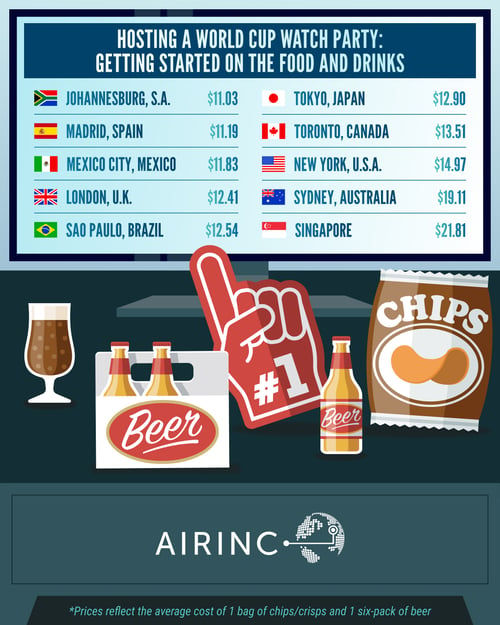
The first is the simpler version: snacks (a bag of chips/crisps) and drinks (a six-pack of beer) for the match.
-
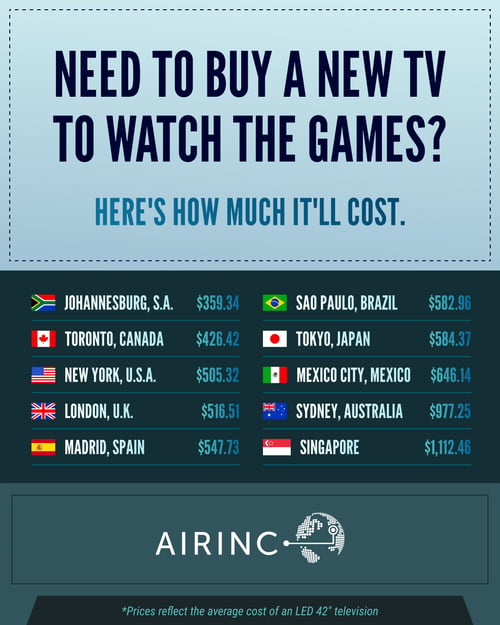
The second adds a bigger-ticket item to the mix: buying a new TV too (LED, 42").
That gives us two ways to think about the cost of joining in, from a casual gathering to a more expensive setup for anyone upgrading their match-day experience!
The cost of a basic World Cup watch party
Our first comparison looks at the cost of a basic watch party with snacks and drinks across the 10 selected expat hubs.
In this ranking, Johannesburg comes in as the most affordable location at $11.03, followed closely by Madrid at $11.19 and Mexico City at $11.83. At the other end of the list, Singapore is the most expensive at $21.81, with Sydney also standing out as a pricier place to host at $19.11.
That means a basic World Cup watch party in Singapore costs nearly twice as much as one in Johannesburg.
For something as familiar as chips, drinks, and watching the match with friends, that is a useful reminder that local consumer prices can vary a lot from one city to another. The event may be the same, but the cost of taking part is not.
What if you need to buy a new TV too?
This is where the comparison gets more dramatic.
When a new TV (LED, 42") is added to the basket, Johannesburg is still the most affordable location in our ranking at $359.34. Singapore, meanwhile, jumps to $1,112.46, making it by far the most expensive city in this comparison.
Other higher-cost locations include Sydney at $977.25 and Mexico City at $646.14, while Toronto at $426.42 and New York at $505.32 sit somewhere in the middle.
The biggest takeaway is simple: a watch party that includes buying a new TV costs more than three times as much in Singapore as it does in Johannesburg.
What stands out from the rankings?
A few things jump out right away.
First, the spread between locations is significant, even for a relatively simple social occasion. A World Cup watch party may feel universal, but the cost of hosting one is shaped by local price levels.
Second, the difference becomes much more pronounced when larger household purchases are involved. Snacks and drinks show meaningful variation, but adding a TV turns the comparison into a much sharper illustration of local purchasing costs.
And third, this is exactly why relatable comparisons work so well. They make cost differences easier to picture. Instead of talking in abstract terms about consumer prices or cost variation, we can anchor the data in something familiar: inviting people over to watch the match.
Why this matters for global mobility
Of course, this comparison is light-hearted by design. A World Cup watch party is not the basis for policy. But it does point to something more serious.
As we discussed in AIRINC’s recent Global Tax Chat, global events can reveal just how much location matters. For athletes, that might mean different tax obligations depending on where matches are played. For internationally mobile employees, it might mean different costs for groceries, household goods, social activities, housing, or everyday life.
For mobility teams, these differences matter not just in theory, but in daily experience. Local prices shape how employees experience a destination, how far budgets stretch, and how companies think about support.
That is why cost-of-living data is most useful when it connects to real life. Whether someone is buying groceries, furnishing a home, or hosting friends for a major sporting event, local prices affect how far their money goes.
A global tournament with local price tags
One of the best things about the World Cup is that people watch it from everywhere. Some will be cheering from stadium seats. Others will be following along from offices, homes, or bars/pubs, thousands of miles away from where the matches are being played.
But while the tournament is global, the cost of joining in is still very local.
From Johannesburg to Singapore, the numbers show just how differently the same occasion can be priced around the world. From snacks and drinks to bigger-ticket household items like TVs, local price differences can quickly shape the cost of everyday experiences, something global mobility teams know well.
And if you would like to talk more about location data, World Cup viewing costs, what it is like to see the tournament live, or how to organise an office pool that keeps everyone checking the standings, we would be happy to compare notes. After all, we work with data every day but some datasets are definitely more fun to debate than others!

%20(1).png)
%20(18).jpg)
%20-%202026-02-04T222549.716%20(1).png)