

.png)
Not all assignment locations are the same. Some locations present additional challenges for assignees and their families, from safety and healthcare concerns to climate, pollution, infrastructure, traffic, and day-to-day living conditions.
A hardship allowance helps companies recognize these challenges and provide additional support when employees are assigned to difficult locations.
Hardship allowances are an important part of many global mobility programs because they create a consistent way to assess location difficulty and determine when additional compensation is appropriate. Various terms are used across mobility programs, including Hardship Premium, Location Allowance, Difficult Location Premium, and Remote Location Allowance. Regardless of the term used, the goal is often the same: to acknowledge challenging assignment conditions in a structured and objective way.
AIRINC evaluates hardship conditions in more than 2,500 locations worldwide using an objective methodology. These evaluations help companies determine which locations warrant a hardship allowance and how much should be paid.
Hardship Webinar
As someone who works closely with mobility teams on hardship policy and location evaluations, I often see how important it is to have a clear, consistent approach. Hardship allowances can be difficult to explain because they involve both data and employee experience. That is why we created this Back to Basics session: to help mobility professionals understand the fundamentals and feel more confident applying them in practice.
Join AIRINC’s new Hardship Back to Basics session for a practical overview of what hardship allowances are, how they are determined and what mobility teams should consider when reviewing their approach.
Join the session that works with your time zone:
-
June 30 | 10:00 AM Boston / 3:00 PM London
-
July 7 | 10:00 AM Hong Kong
-
July 8 | 10:00 AM San Francisco / 1:00 PM Boston

Why Hardship Allowances Matter
Hardship allowances help mobility teams balance employee support, program consistency, and business needs. For assignees, the allowance recognizes that living and working conditions can vary significantly from one location to another. For employers, it provides a structured way to evaluate location difficulty and apply compensation consistently across the assignment population.
This is especially important because assumptions about locations can quickly become outdated. A location that was once considered highly challenging may improve over time as infrastructure, healthcare, housing, or transportation develops. Conversely, political instability, economic disruption, environmental conditions, or security concerns can increase assignment complexity.
In conversations with clients, one of the most common challenges is not simply determining the allowance, but explaining the “why” behind it. Employees and business stakeholders want to understand how a location was evaluated and why one location may receive a different recommendation than another. A consistent methodology gives mobility teams a stronger foundation for those conversations.
Your Hardship Options
It is important to offer a hardship allowance that is aligned to your mobility program goals and competitive for your industry. AIRINC’s hardship allowance methodology uses an objective, flexible approach that allows you to either select our standard recommendation or tailor the allowance to your needs.
Each location is evaluated for a total possible score of 0–100 points. These points are translated into a percentage using a hardship allowance scale. Higher points translate into a higher percentage recommendation to apply to the employee’s salary.
You can choose the standard AIRINC scale, starting at 0% and increasing to a maximum of 30% in 5% increments. Or, you can choose a configured scale with different maximums or increments to better align with your company’s mobility philosophy.
.png?width=666&height=399&name=Blog%20Images%202026%20(38).png) Changes in Hardship
Changes in Hardship
Conditions in locations can change suddenly, slowly over time, or remain relatively stable. Staying on top of changing conditions allows you to effectively support your hardship program and communicate clearly with assignees and stakeholders.
AIRINC clients are supported by dedicated hardship experts who proactively share updates when allowances change. Our experts are also available to help explain allowances, discuss competitive hardship allowance practices, and provide more detail about our assessments.
Regular review is important because hardship is not a one-time determination. Local conditions, employee expectations, and company mobility policies can all evolve over the course of an assignment.
How You Access Hardship Allowances
Whether you need data for one location or hundreds, AIRINC delivers the hardship allowance information you need to support your program. For each location, you receive a hardship evaluation and recommended hardship percentage. This provides both the final recommendation and the details behind the evaluation.
The hardship evaluation details AIRINC’s assessment of 100 total points across key categories that reflect the challenges assignees may experience in the host location.
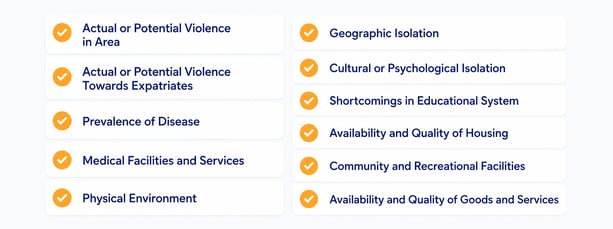 Ordering and Allowance Delivery
Ordering: You can order hardship allowances as needed or subscribe to a set of data on an annual basis.
Allowance delivery: Detailed hardship evaluations can be accessed online through AIRINC’s portal, AIRLINC. Recommended hardship percentages can also be integrated through API connections or delivered in the format required by your technology system.
How We Calculate Hardship Allowances
AIRINC’s dedicated hardship research team continuously researches location conditions across the globe. AIRINC provides hardship evaluations for more than 2,500 locations worldwide.
Our sources include:
-
AIRINC on-site research
-
Interviews with expatriate personnel
-
AIRINC in-house research of published sources, including the United States State Department, Foreign, Commonwealth & Development Office, Bureau of Labor Statistics, iJet, The Centers for Disease Control and Prevention, The World Health Organization, International SOS, INTERPOL, BBC, CNN, and Reuters
Your Hardship Partner
With its objective and flexible approach to hardship, AIRINC delivers recommendations based on a globally consistent method that can be tailored to your global mobility program.
When you choose AIRINC as your hardship provider, you get more than just data. You gain access to a dedicated team of experts who can help support your program, explain changes, and provide the insight needed to make confident mobility decisions.
Learn More About Hardship Allowances
Hardship allowances can be complex, especially as location conditions change and mobility teams work to balance consistency, competitiveness, and employee support. A clear methodology helps companies make informed decisions and communicate those decisions with confidence.
If you are new to hardship allowances, revisiting your current approach, or simply looking for a clearer way to explain hardship to your stakeholders, this session is a useful starting point.




Subscribe to our blog to stay updated on changes around the world that impact Global Mobility.

%20(21).jpg)

%20(1).png)