

Reducing international assignment costs doesn't always mean cutting employee benefits.
By modelling and comparing different cost scenarios, Global Mobility teams can explore changes to assignment timing, policy benefits and other assumptions to identify potential savings.
In one Houston-to-London assignment, changing the start date by just one month reduced the estimated incremental cost to the company by USD 30,288, without changing the employee's benefits package.
But the real opportunity wasn't simply finding a saving. It was having the flexibility to keep exploring different options rather than treating the first cost estimate as the final answer.
How Can Companies Reduce International Assignment Costs?
The assignment was nearly ready for approval.
An employee was moving from Houston to London on a long-term international assignment. The mobility policy had been applied, the start date agreed and the original cost estimate completed.
Then the business saw the total.
“Can we bring that down?”
The most obvious response was to look at the package. What benefit could be reduced or removed? Was the mobility premium necessary? But maybe that wasn't the only option.
Mobility began with the original policy scenario, which included the standard mobility premium and a March 30 assignment start date. Then the team modelled two alternatives.
Scenario 1: What Happens If You Remove the Mobility Premium?
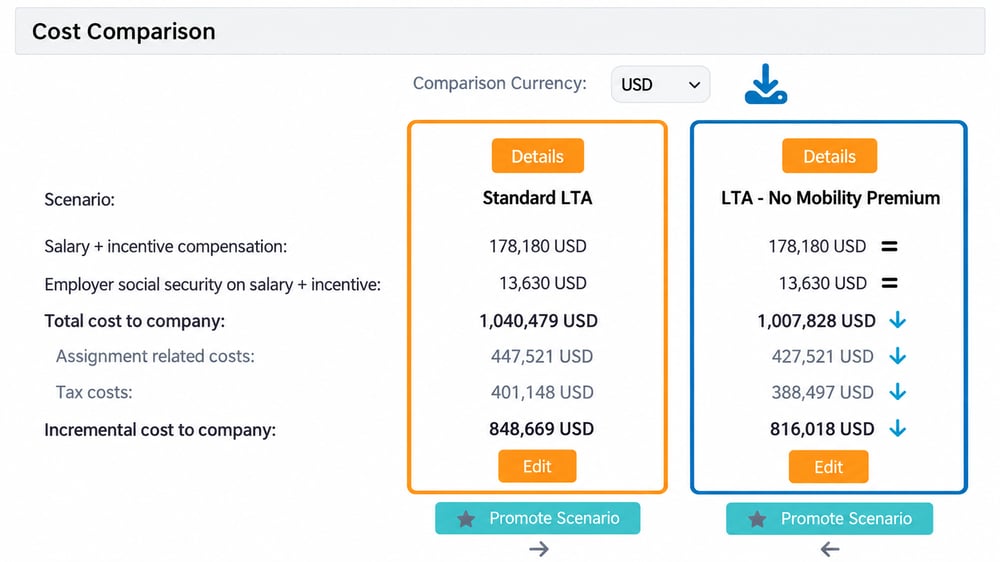
The first scenario was straightforward. Remove the mobility premium from the assignment package. Estimated incremental cost saving: USD 32,651.
The saving was immediate, but it came directly from the employee's package. The employee would no longer receive the payment intended to recognize the disruption of an international move.
The cost estimate was lower, but there was a clear trade-off.
Navi international assignment cost comparison showing savings from removing the mobility premium
What if Mobility could find similar savings without changing the employee's benefits?
Scenario 2: Can Changing an Assignment Start Date Reduce Costs?
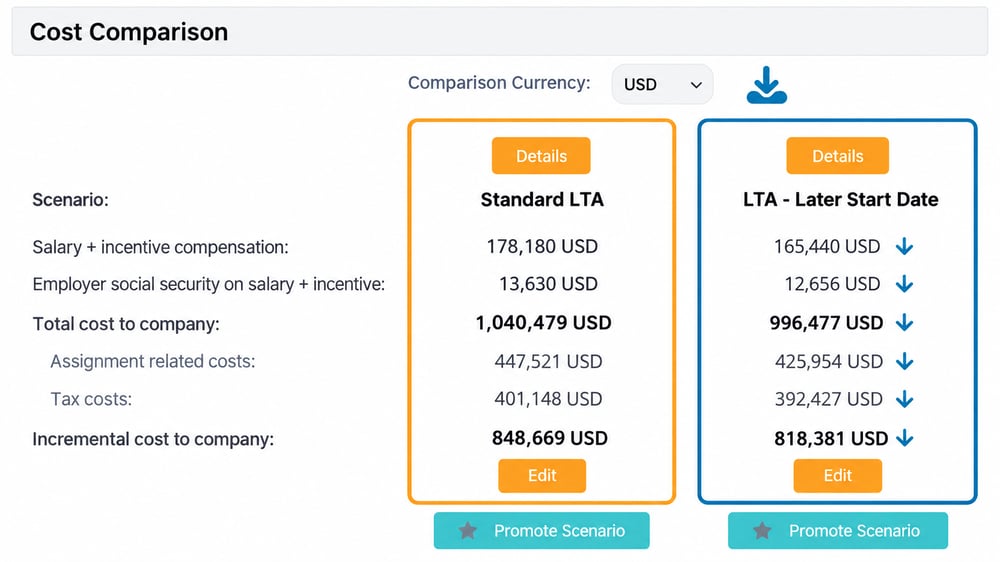
For the second scenario, Mobility left the employee's package alone. Instead, the team changed the assignment start date from March 30 to April 30. That moved the employee's arrival fully into the new UK tax year, which begins on April 6.
In this particular scenario, the revised timing aligned the assignment more favorably with the host-country tax year and reduced the overall estimated cost. Estimated incremental cost saving: USD 30,288.
Same employee. Same assignment. Same benefits package. Just a different start date.
Navi assignment cost scenario modelling showing savings from a later assignment start date
Both scenarios reduced the estimated incremental cost by more than USD 30,000.
But they did so in very different ways.
One created savings by taking something out of the employee's package. The other found savings by changing the timing of the assignment.
Of course, changing an assignment start date won't always deliver savings. Tax outcomes depend on the circumstances of the assignment, applicable tax rules and the assumptions used in the estimate.
But without modelling the alternative, Mobility might never have identified the opportunity.
Which Assignment Cost Scenario Delivers the Better Outcome?
Both scenarios delivered significant potential savings, but comparing them tells a more interesting story.
|
Scenario |
Estimated incremental cost |
Saving vs original |
|---|---|---|
|
Standard long-term assignment |
USD 848,669 |
— |
|
Remove mobility premium |
USD 816,018 |
USD 32,651 |
|
Move start date by one month |
USD 818,381 |
USD 30,288 |
The difference in savings between the two alternatives was just USD 2,363. So which is the better option? That depends on the business.
There may be operational reasons why the start date cannot move. The mobility premium may also be an important part of the employee's assignment package.
But the comparison makes the trade-offs visible. Instead of looking at separate cost estimates, the business can see what changed, how much it saved and what that means for the employee.
And the conversation becomes about choosing the most appropriate option, rather than simply finding the lowest number.
What If You Could Keep Testing Different Assignment Cost Scenarios?
A cost estimate tells you what an assignment might cost. But what happens when the business wants to change something? What if the employee starts a month later? What if the mobility premium stays? What if the assignment duration changes? Each question introduces another scenario to explore.
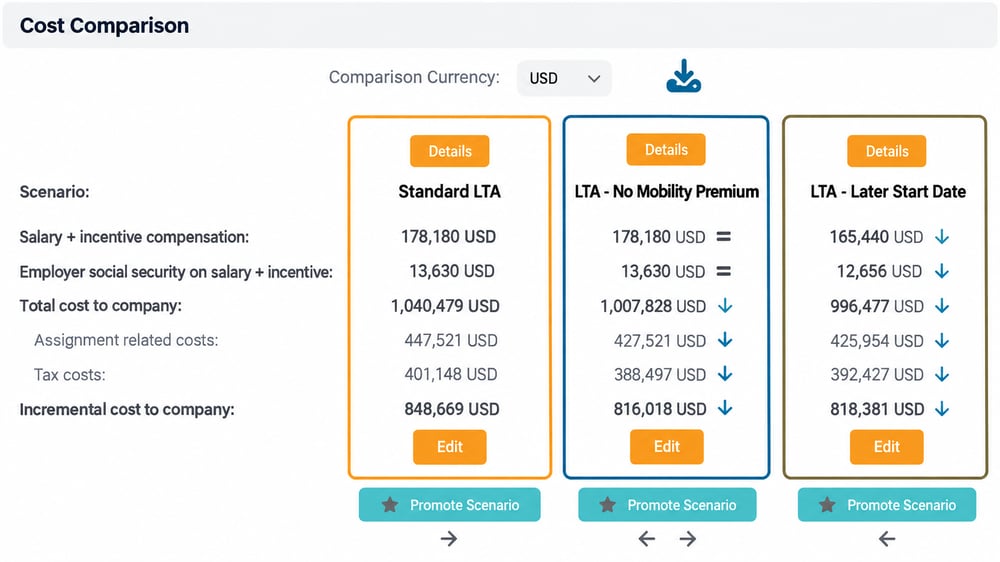
Traditionally, businesses may commission assignment cost estimates from external providers, including the Big Four accounting firms. These estimates support important planning and budgeting decisions, but exploring different assumptions may involve requesting revised calculations. With Navi, Global Mobility teams can adjust assignment assumptions, run alternative cost scenarios and compare the results side by side. In our Houston-to-London example, Mobility tested two alternatives. But what if neither option worked for the business?
The team could continue exploring other possibilities, changing assumptions and comparing the financial impact. The process doesn't have to end with the first estimate. Or even the first two alternatives. The original cost estimate becomes a starting point for exploring options, rather than simply a number to approve or reject.
Navi cost comparison dashboard displaying three international assignment cost scenarios side by side
And that's where scenario modelling becomes particularly valuable.
Mobility doesn't necessarily need to know which change will deliver the best outcome before it starts exploring.
It can test different possibilities, see what changes and use the results to guide the conversation.
How Does Scenario Modelling Help Global Mobility Teams Make Better Decisions?
When assignment cost estimates are reviewed individually, it's easy to focus on the total at the bottom. A lower number looks like a lower number.
But that doesn't tell you what made it lower. Was a benefit removed? Did the assignment duration change? Was the saving driven by tax assumptions or assignment timing? Understanding those differences matters.
With Navi, Mobility can place the original policy scenario alongside different alternatives and compare the financial impact of each one. That helps the business understand not just how much an assignment might cost, but what happens when different decisions are made.
It also gives Mobility more flexibility to respond when business requirements change. Rather than treating every new question as a separate cost estimate, the team can continue modelling alternatives and exploring the options available. The comparison doesn't make the decision.
There may still be business, employee, tax or operational considerations that determine which scenario is feasible. But it gives everyone a clearer view of the financial implications before that decision is made.
Does International Assignment Cost Optimisation Always Mean Reducing Benefits?
No. International assignment cost optimisation can involve changing assignment timing, duration, compensation assumptions or policy variables, rather than removing employee benefits.
The Houston-to-London example shows why looking beyond the package matters.
-
Removing the mobility premium reduced the estimated incremental cost by USD 32,651.
-
Moving the assignment start date reduced the estimated incremental cost by USD 30,288, while leaving the employee's benefits package unchanged.
Neither scenario was automatically the right choice. But having the ability to model and compare both gave the business options it might not otherwise have considered.
And if those options didn't work, Mobility could keep exploring. That's the real value of scenario modelling.
It's not simply about producing a lower estimate. It's about understanding what drives assignment costs, testing different possibilities and helping the business make more informed decisions.
A cost estimate tells you what an assignment might cost. Scenario modelling helps you discover what it could cost instead.
Because saving money doesn't always have to mean cutting the package.