
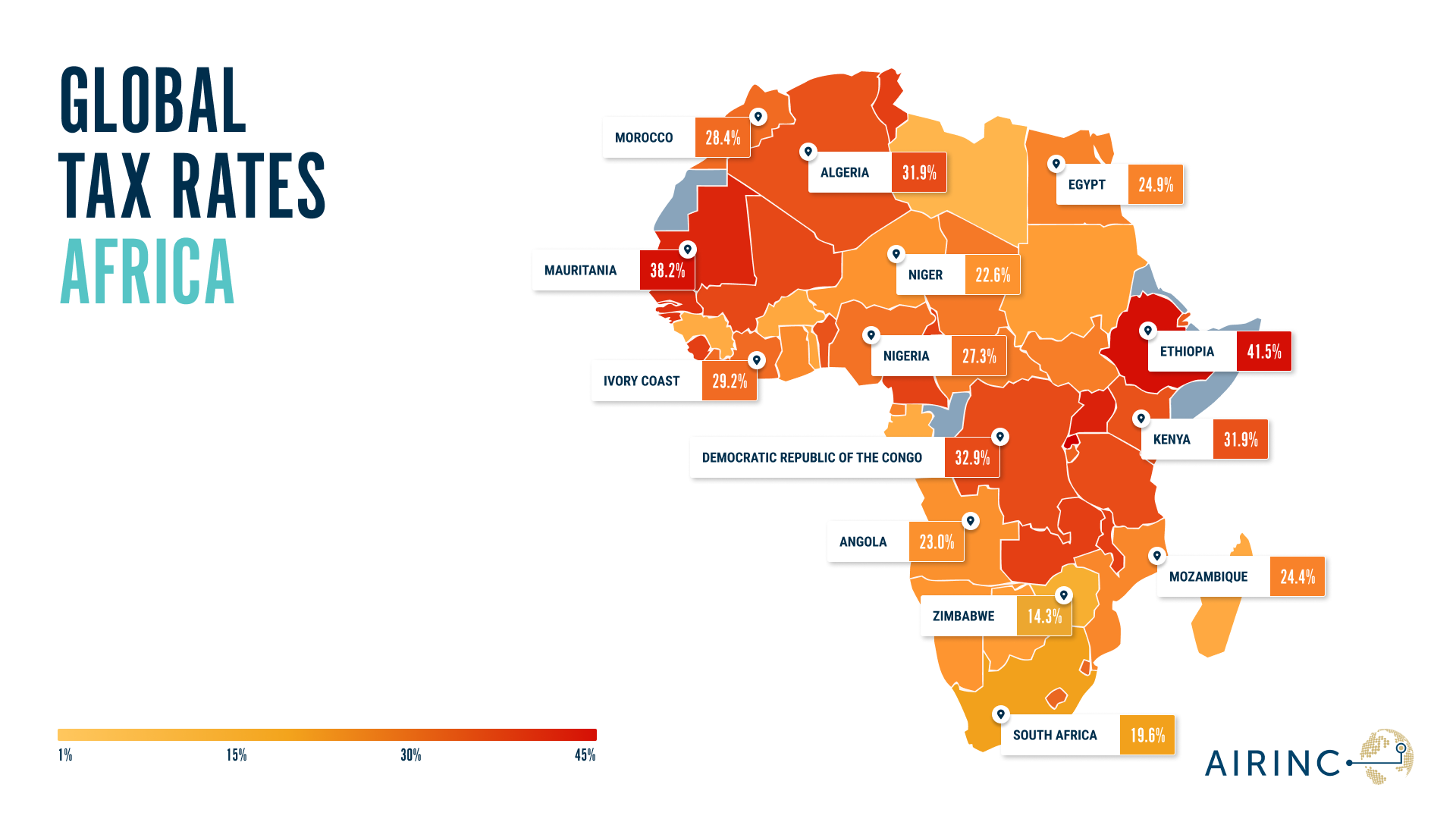
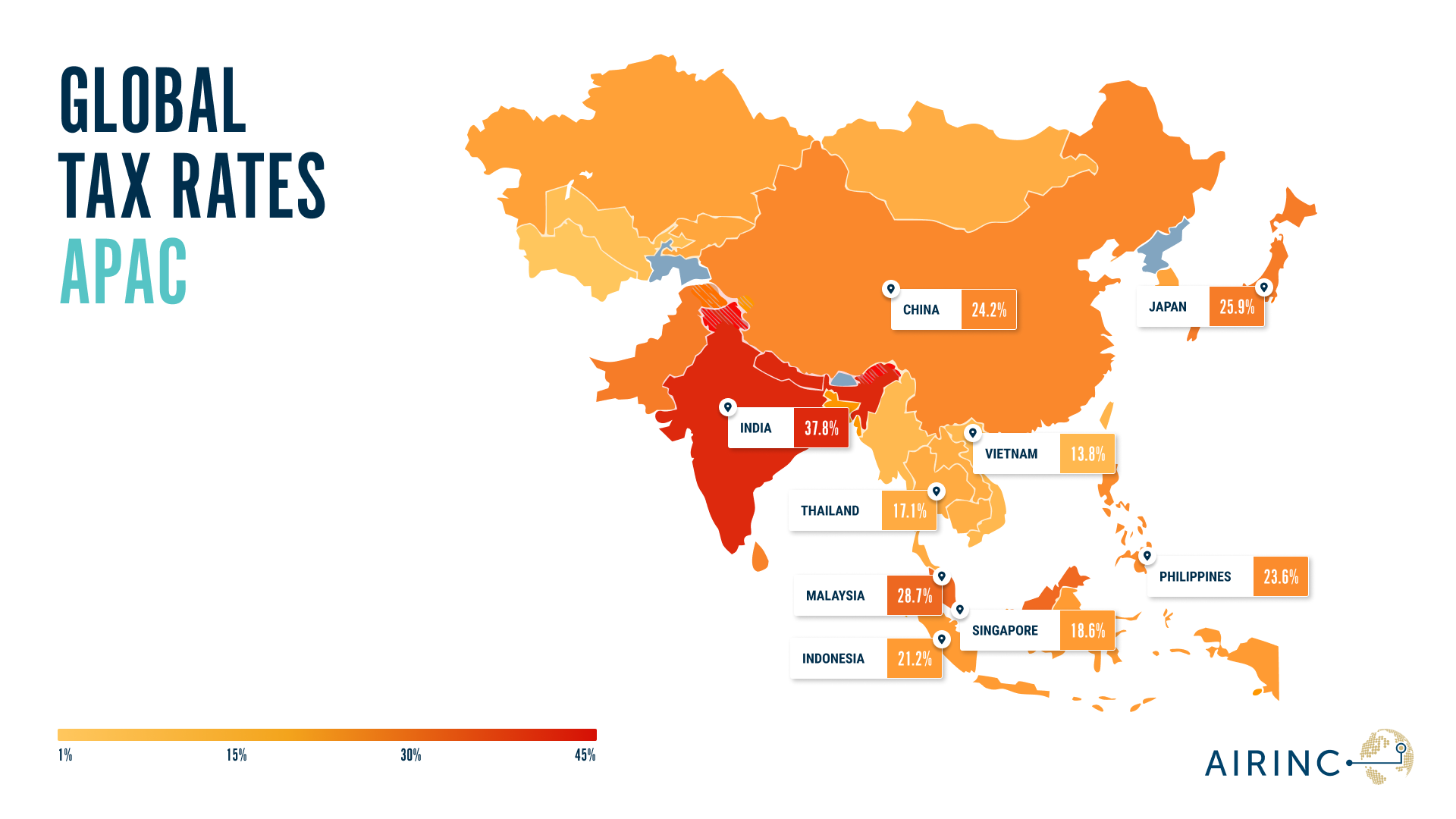
AIRINC’s 2026 Global Tax Rates map has been updated, giving mobility teams a fresh view of how tax rules affect take-home pay around the world.
In Africa, the tax landscape remains especially varied. The region includes countries with highly developed tax systems, countries actively modernizing their tax frameworks, and countries where informal economies or enforcement challenges can complicate compliance. Furthermore, there are few bilateral and multilateral tax treaties and totalization agreements across the region.
For companies managing assignments into or within Africa, the key takeaway is clear: tax outcomes can differ significantly by country, income level, family situation, and local rules. Accurate, location-specific tax planning is therefore essential for assignment cost projections and employee communication.
Which African countries had the largest effective tax rate increases in 2026?
Rwanda – increased 5%
Certain deductions have been eliminated, while social security rates have increased. The income tax rate schedule itself is unchanged, but the overall effect is an increase in tax and social security costs for all taxpayers.
The government has introduced higher pension contribution rates that will be phased in over a five-year period. This year, the total combined employee contribution rate increases from 10.8% to 14.3% of wages, with no contribution ceiling. Rates are scheduled to increase gradually over the next five years, resulting in an additional four percentage points for both employees and employers by January 1, 2030.
Burundi – increased 4%
The tax brackets have been narrowed, resulting in more income being subject to higher tax rates. The net effect is an increase in tax for all taxpayers.
Which African countries had the largest effective tax rate decreases in 2026?
Equatorial Guinea – decreased 7%
The tax rate schedule has been adjusted, with the top marginal rate reduced from 35% to 25%. The net effect is a decrease in income tax for all taxpayers, alongside a small increase in social security because the Worker Protection Fund is calculated on after-tax income.
Zimbabwe – decreased 8.5%
The Zimbabwe Revenue Authority has expanded the tax brackets, resulting in more income being subject to lower rates. The net effect is a decrease in income tax for all taxpayers, although social security costs increase at higher income levels.
Why Africa is not one tax story
Africa should not be treated as a single tax environment. Tax systems vary widely across the continent in terms of tax rates, social security systems, and the sophistication of the authorities responsible for administration and enforcement.
Many African countries are actively modernizing their tax frameworks to meet today’s economic and compliance challenges. The continent includes countries with more developed systems, such as South Africa and Morocco, as well as countries facing challenges associated with tax evasion, dependence on oil revenues, and large informal sectors, including Nigeria and Angola.
For mobility teams, this means regional assumptions can be misleading. A tax approach that works in one African country may not apply in another. The continent’s limited treaty landscape is an important part of that complexity, particularly for employers with mobile workforces.
Only about 7% of African country combinations have bilateral social security treaties in force. Income tax treaty coverage is somewhat broader, but still limited, with bilateral income tax treaties in force for approximately 11% of African country combinations.
We have heard similar observations from clients based in the region. Cross-border tax planning for mobile employees can be hampered by the lack of coordination between national tax systems.
Reflecting this challenge, I asked AIRINC Advisory Director Claire Fielding what she has been hearing during client visits in Botswana and Ghana. While the network of Double Taxation Agreements (DTAs), or tax treaties, between African countries is growing — South Africa, for example, has treaties in force with Tunisia, Uganda, Zambia, Tanzania, and Zimbabwe — coverage remains inconsistent across the continent.
Claire highlighted:
“As cross-border mobility within Africa continues to grow, companies are looking to adopt early tax planning as part of a more proactive management approach. However, as treaty coverage remains inconsistent, similar employee moves can result in very different tax outcomes depending on the home- and host-country combination.”
Why this matters for global mobility teams
Tax changes across African countries can affect assignee take-home pay, assignment cost projections, tax equalization, payroll planning, and compliance.
Mobility teams may need to revisit their assumptions when moving employees into countries where tax rates, deductions, social security contributions, or filing rules have changed.
Country-specific analysis is especially important in Africa because tax systems are evolving at different speeds. Employees may also need clear communication when changes affect their expected net pay.
Tax planning is not simply about headline rates. It requires an understanding of the full tax burden and how it applies to an employee’s individual circumstances.
How AIRINC’s Global Tax Rates map helps you
AIRINC’s Global Tax Rates map gives mobility teams a visual way to compare tax outcomes across countries. In Africa, the map can help identify where tax burdens are higher or lower and where mobility teams may want to investigate the underlying rules in more detail.
The map can serve as a starting point for conversations with tax, payroll, HR, and finance teams. It can also help mobility professionals explain complex tax differences to stakeholders who do not work with tax data every day.
Summary
Explore AIRINC’s updated Global Tax Rates map to compare how taxes affect take-home pay across Africa and other regions.
For more detailed assignment planning, AIRINC’s tax data and advisory support can help mobility teams understand how tax changes affect cost projections, compliance, and the employee experience.

Webinar: Global Mobility Tax: The Essentials Refresher
Session 1: What is Mobility Tax?In this first session, we discussed:
|
Session 2: Tax and Mobile Compensation
|
Session 3: Tax Considerations for Different Assignment Types
|
|
Session 1 WATCH AGAIN |
Session 2 REGISTER |
Session 3 REGISTER |
%20(1)-1.png)
%20(18).jpg)